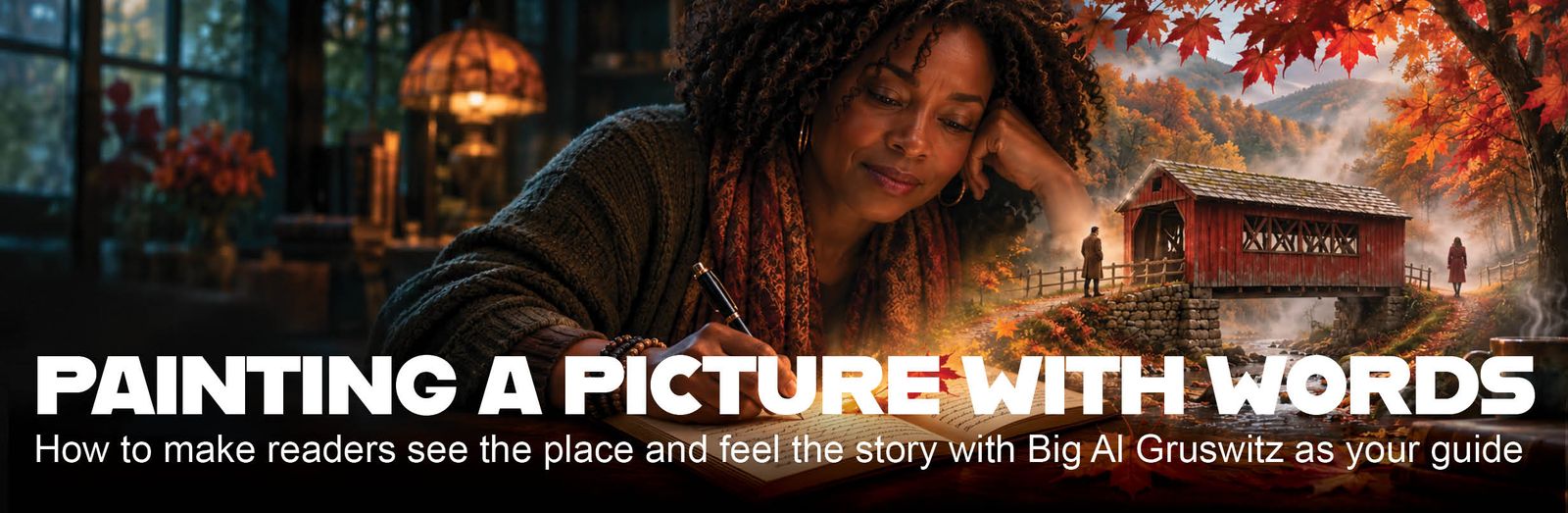
PAINTING A PICTURE WITH WORDS
How to make readers see the place and feel the story. Four 90-minute sessions.
Have you ever read a scene so vivid you could picture yourself there? Or felt a goodbye coming before either character said a word? In this Master Class, we’ll explore how writers shape those responses through the details they choose, what they reveal, and when they reveal it.
We’ll start with Al’s short film Leaves, drawn from places he knew (the Vermont landscape, the cider mill, the covered bridge) to make a fictional memory feel true. We’ll also look at scenes from his soon-to-be-released TV pilot to see how a detail planted early can shape what the audience feels several scenes later.
Bring a scene you’re working on or start with a place you know well. You’ll leave with a revised scene and a way to find out whether your writing is reaching readers the way you hoped.
The four sessions
Draw on what you know
How details from life make an invented story feel true, like the sugar from a doughnut on someone’s fingers or the sound of a game nearby.
In class: Recall a place you can still picture, list five details (one a photograph couldn’t capture), and draft the opening of a scene.
See the place through your character’s eyes
What your character notices can tell readers how they feel without naming the emotion.
In class: Write the same place twice: arriving eager to see someone you love, then leaving after saying goodbye.
Shape what the reader feels, moment to moment
When do you let the audience know more than the character? When do you hold something back? How long do you let an uneasy moment last?
In class: Rewrite your turning point two ways and compare how timing changes what readers expect.
Find out what reached the reader, and revise
Share scenes before telling the group what you intended, and hear where readers could picture it, what they felt, and which words prompted that response.
In class: Make one focused revision, then read it aloud and see what changed.